The challenge
Jamieson Brown is Economic Development Manager for the Town of Vegreville, a community of about 6,000 in central Alberta. For a town that size, the hardest part of the job isn’t finding data. It’s producing enough credible, on-message content to stay visible to investors and site selectors.
“We’re really trying, for a community our size, to punch above our weight,” Brown said. He treats content as the whole game, and generating fresh material week after week with a small team is the part most likely to slip when everything else competes for attention.
The approach
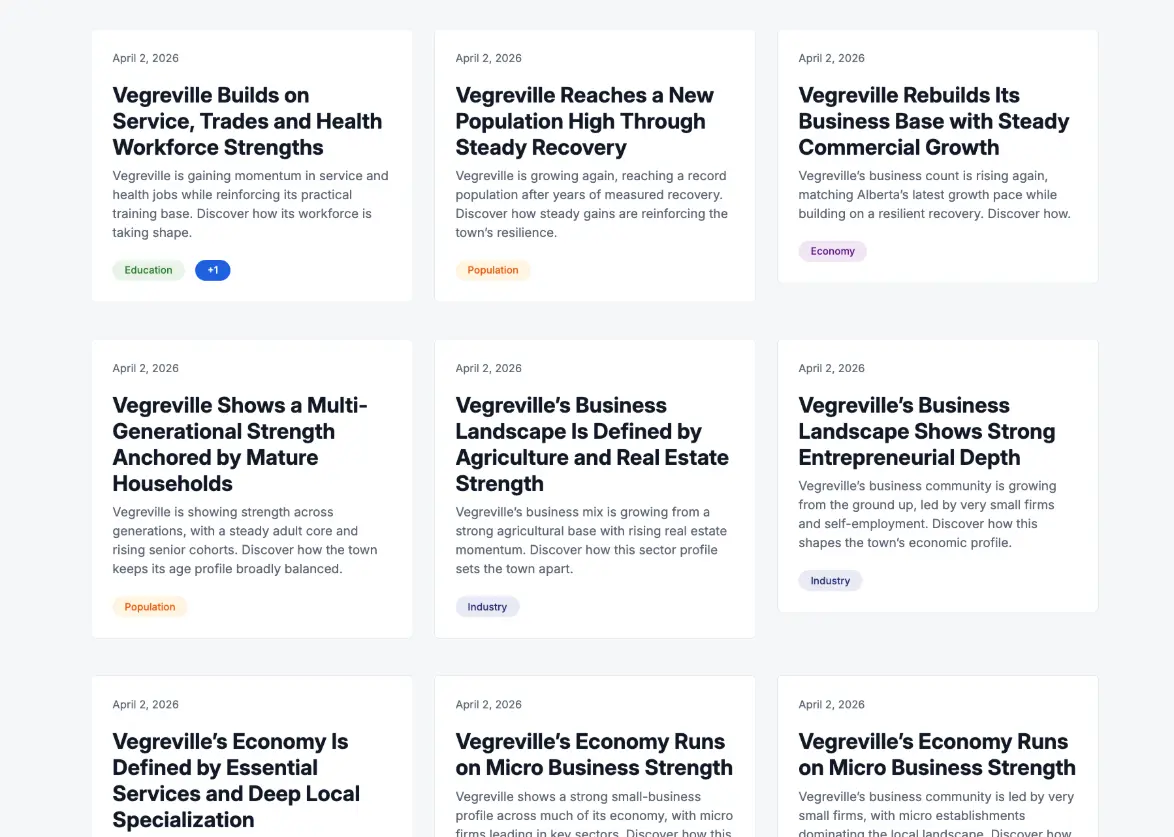
Vegreville uses Localintel One as both an idea source and a content engine. Brown goes into the platform to find angles he wasn’t looking for. Reviewing the town’s own numbers, he found a story in its population recovery and growth, five straight years of increase after two years of decline, reaching nearly 7% in 2025. “I wouldn’t have thought about that without seeing this.” That became a story he could publish on the website and share through the town’s social channels.
That content now runs across the Choose Vegreville website. The population narrative sits on the Demographics and Market Overview page, alongside workforce and market dashboards. A logistics and accessibility dashboard anchors the transportation page, and a quality of life dashboard supports the lifestyle page.
Brown stays in control of the message. He doesn’t publish platform output as-is. He reviews it, takes the pieces that fit, and shapes them to Vegreville’s story, setting aside anything off message. The platform supplies the raw material and the starting point. The judgment stays with him.
“It’s really taken a load off our shoulders. You don’t have to go have a brainstorming session. It’s all right there.”
The result
A one-person economic development office keeps a full investment website current and produces a steady stream of story ideas and published content, the kind of output that usually takes a larger team or outside help. The data is sourced and current, the ideas keep coming, and the team decides what to say and how to say it.
The ideas and the data come from the same place, which is why the stories hold up when someone checks them.